Software Engineer Salary in India (2026): By Experience, City & Company
Software engineering is India's largest professional category — with salaries that range from ₹4L for a service-company fresher to ₹150L+ for a Staff Engineer at a FAANG office. Where you fall on that curve depends on your experience band, city, company type, and the specific skills you hold. This guide breaks down indicative 2026 salary estimates across all four dimensions, so you have figures to benchmark your worth and plan your next move.
Key insight: The biggest salary lever for Indian software engineers isn't years of experience — it's company type. A mid-level SWE at TCS earns ₹12–18L. The same engineer at a Bangalore unicorn earns ₹30–50L. Switching from service to product is the single fastest salary move available in Indian tech.
Key figures at a glance
- Fresher (0–1 yr)
- ₹3.5L – ₹9L (₹6L typical)
- Junior (1–3 yr)
- ₹8L – ₹18L (₹12L typical)
- Mid-level (3–5 yr)
- ₹15L – ₹32L (₹22L typical)
- Senior (5–8 yr)
- ₹26L – ₹56L (₹38L typical)
- Staff / Lead (8+ yr)
- ₹40L – ₹90L (₹60L typical)
Salary ranges on Pathvio are estimates compiled from salary information published across multiple job portals. They show the CTC range you can typically expect for a role, based on your years of experience, job role and skills. They are not an exact or fixed figure, and not a promise of what any employer will offer: actual pay depends on the company, the location, your interviews and how the offer is negotiated.
Indicative estimates compiled from external salary information · Annual CTC in INR · About these figures
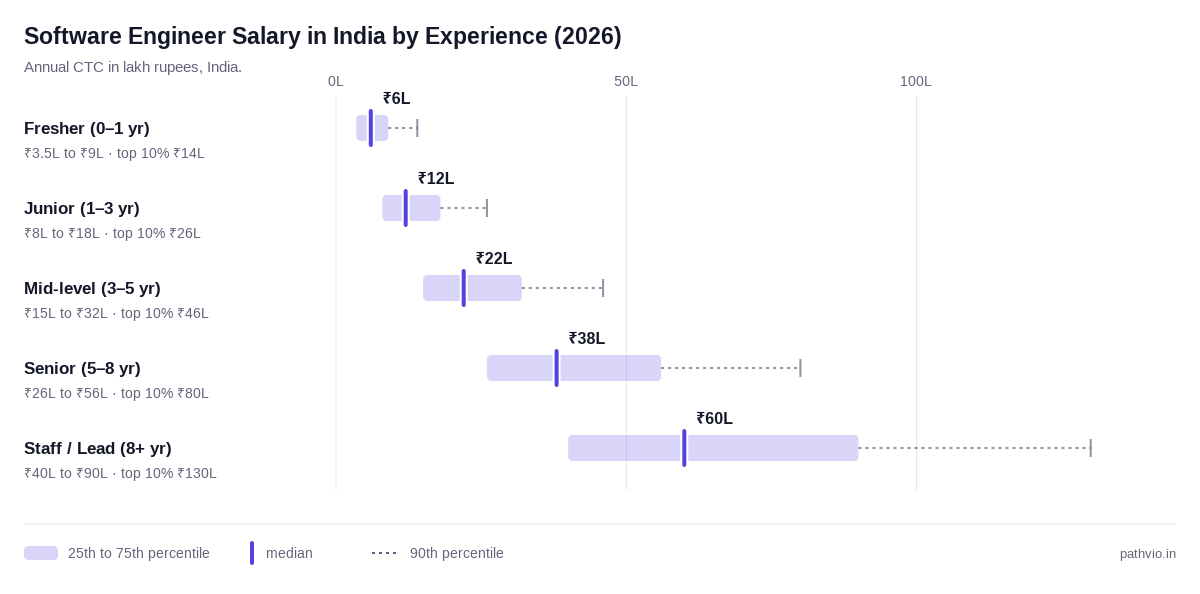
Software Engineer Salary by Experience in India
All figures are annual CTC in Indian Rupees, shown as indicative ranges (low end, typical, high end, ceiling) — not survey percentiles.
Campus / off-campus entry roles. Service cos dominate volume.
First job switch or internal promo. Biggest delta from service vs product.
Core execution, highest hiring demand. System design separates bands.
Scope expansion, mentorship expected. FAANG gap widens sharply here.
Architecture ownership, cross-team influence. ESOPs can add meaningfully on top.
| Experience Band | Low end | Typical ↑ | High end | Ceiling |
|---|---|---|---|---|
| Fresher (0–1 yr) | ₹3.5L | ₹6L | ₹9L | ₹14L |
| Junior (1–3 yr) | ₹8L | ₹12L | ₹18L | ₹26L |
| Mid-level (3–5 yr) | ₹15L | ₹22L | ₹32L | ₹46L |
| Senior (5–8 yr) | ₹26L | ₹38L | ₹56L | ₹80L |
| Staff / Lead (8+ yr) | ₹40L | ₹60L | ₹90L | ₹130L |
Asked for your expected CTC, or holding an offer near these numbers? How to negotiate salary in India
Software Engineer Salary by City
Estimated difference vs India-wide, by city. These are indicative ranges compiled from salary information published across job portals, not exact offers.
Highest density of product cos and FAANG offices. Best ecosystem for product SWEs.
View Bangalore salary guide →
Finance-tech and BFSI premium. Fintech hub — PhonePe, Razorpay, Groww.
View Mumbai salary guide →
Large MNC presence, govt-adjacent tech orgs, ed-tech companies.
View Delhi NCR salary guide →
Growing product ecosystem with Microsoft and Amazon India offices. Lower cost of living.
View Hyderabad salary guide →
Mostly service organisations; fewer product-first companies in active hiring.
View Pune salary guide →
Service-heavy market. Emerging product scene but pay bands lag by 2–3 years.
View Chennai salary guide →
Software Engineer Salary by Company Type
Company type is a major salary variable in India — often as important as years of experience.
Stable, large scale, onsite opportunities. Limited salary upside without switching.
Good scope and ownership. Moderate equity. Strong resume brand for future switches.
Fast-paced, real scale. Strong ESOP upside at pre-IPO stage. High bar for interviews.
Top-tier compensation. Requires strong DSA, system design, and behavioural rounds.
Skills That Boost Your Software Engineer Salary
Indicative skill premiums. Actual pay depends on role, employer and experience.
Rare at mid-level; the gating skill for senior+ roles at every product company.
Every product company runs on cloud. Certified engineers often command a premium.
SRE and platform roles often pay above standard SWE — and demand is outpacing supply.
Engineers who can build AI features independently command the highest 2026 premium.
High-performance backend roles in fintech and infra. Niche but well-paid.
Software Engineer Career Path in India
Software engineering in India has a well-defined ladder — but the salary jumps come from scope, not tenure. Here's what each step actually requires, beyond just time served.
Ship features independently without hand-holding, own a service end-to-end, and demonstrate solid fundamentals in code reviews. The gate here is reliability — being the engineer a lead can assign a task and forget about.
System design becomes the hard gate. You're expected to break down ambiguous problems, make architecture trade-offs, and mentor juniors. This is where service-company engineers stall and product-company switches pay off most.
Influence beyond your own code — driving technical decisions across teams, owning a domain's architecture, and multiplying other engineers' output. ESOPs can start adding meaningfully on top of cash at this level.
India increasingly pays Staff ICs on par with EMs. Choose IC if you want to stay close to systems; choose EM if you're energised by growing people. Switching back from EM to IC is harder than the reverse — decide deliberately.
Software Engineer Interview Process in India
What a software engineer interview looks like at an Indian product company or unicorn in 2026. Service companies are lighter (often just 1–2 technical rounds); FAANG India adds a bar-raiser.
2–3 medium DSA problems on HackerRank, CodeSignal, or Codility within 60–90 minutes. Used to filter high-volume applicant pools.
Prep tip: Grind the Blind 75 list and time yourself. Most rejections here are from not finishing, not from wrong logic.
Live coding on arrays, strings, trees, graphs, and dynamic programming. Interviewer probes your thought process, not just the final answer.
Prep tip: Narrate as you code and state your time/space complexity unprompted — it signals seniority even on an easy problem.
Design a scalable system (URL shortener, rate limiter, news feed). Tests data modelling, API design, caching, and trade-off reasoning.
Prep tip: Always start by clarifying scale and requirements before drawing boxes. Jumping to a solution is the most common red flag.
Past projects, ownership stories, conflict handling, and why this company. Often where the leveling (SDE-2 vs Senior) is decided.
Prep tip: Prepare 4–5 STAR stories with real metrics. 'Reduced API latency 40%' beats 'improved performance' every time.
Free Tools Before You Apply
From the Pathvio Blog
Naukri Resume Score & Grading System, Explained
We found no score out of 100 on a Naukri web profile. What it shows instead, and how to fill the grading system field.
Read articleMaking the Service-to-Product Company Switch
A high-leverage career move for Indian engineers, done right.
Read articleThe ATS-Safe Resume Format for India
The formatting choices that help or hurt parsing on Indian ATS platforms.
Read articleSalary Negotiation in India
Exact scripts for the expected-CTC question and the offer call, and what to negotiate when fixed pay won't move.
Read articleFind out exactly where you stand
Pathvio analyses your profile and pinpoints where you fall on the Software Engineer salary curve — then gives you a personalised roadmap to move up. Free, no credit card required.
Get your free salary reportFree · Sign in with Google · No credit card