How to Switch from TCS/Infosys to a Product Company in India: What Actually Works in 2026
- The switch is possible at 3–8 YOE — after that the path gets significantly harder.
- The salary jump is typically 2–3× your service company CTC at the same experience level.
- The 5 skill gaps to close: system design, DSA, product mindset, ownership narrative, modern tech stack.
- Referrals convert 4–6× higher than cold applications — build the network before you need it.
- Target funded startups or mid-size product companies first, not FAANG — use them as a stepping stone.
Every year, hundreds of thousands of Indian engineers at TCS, Infosys, Wipro, Cognizant, and HCL make the same decision: stay comfortable, or switch to a product company and 2–3× their salary in 6–12 months. This guide is for the ones who've decided to switch — and want a concrete plan, not generic advice.
Why the switch is harder than it looks (and how to fix each barrier)
It's not that service company engineers are less skilled. It's that service work doesn't produce the specific signals product companies look for. Here's the gap, and the fix:
Your resume reads like a task list, not an ownership story
Rewrite every bullet to answer: 'What did you build, who used it, and what changed because of it?' Service companies have users too — even internal tools. Count them.
You haven't done a system design interview before
Product companies test system design at every level from SDE-2 upward. This is a learnable skill — 6–8 weeks of focused practice closes most of the gap.
Your LeetCode is rusty (or non-existent)
Service company work rarely involves DSA. 8–10 weeks of LeetCode Mediums (3/day) is the standard preparation timeline that works.
No product company network
You don't need to know people at product companies — you need to connect with ex-colleagues who've already made the switch. Every service company has alumni at product companies. LinkedIn makes them findable.
No side project or open-source contribution
A deployed side project with a public GitHub repo takes 4–6 weeks to build. It doesn't need users — it needs to demonstrate you can own something from idea to production.
The real salary jump: service company → product company
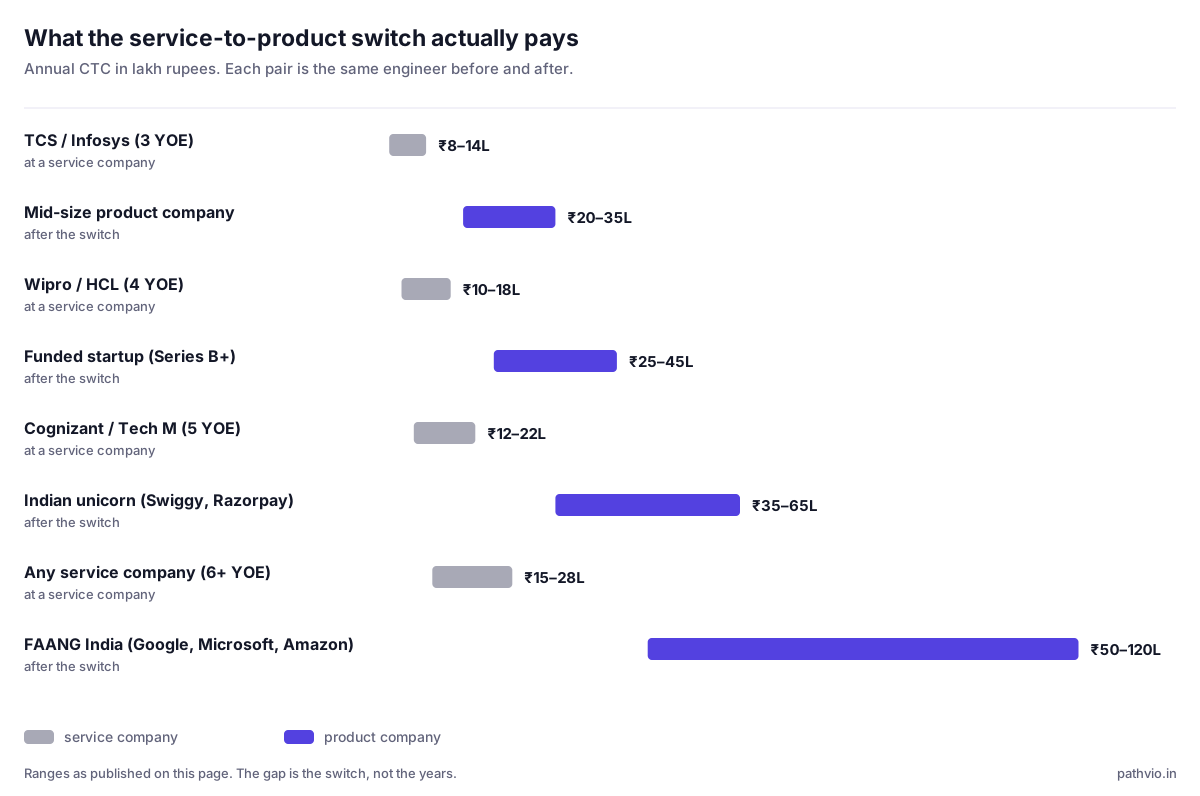
This is what actually happens to compensation when Indian engineers make this switch. These are 2026 figures based on Pathvio's salary data and r/developersIndia thread analysis.
| Current role | Current CTC | Target company type | Expected CTC | Jump |
|---|---|---|---|---|
| TCS / Infosys (3 YOE) | ₹8–14L | Mid-size product company | ₹20–35L | 2–2.5× |
| Wipro / HCL (4 YOE) | ₹10–18L | Funded startup (Series B+) | ₹25–45L | 2–3× |
| Cognizant / Tech M (5 YOE) | ₹12–22L | Indian unicorn (Swiggy, Razorpay) | ₹35–65L | 2.5–3× |
| Any service company (6+ YOE) | ₹15–28L | FAANG India (Google, Microsoft, Amazon) | ₹50–120L | 3–5× |
| Source: Pathvio salary analysis, India, 2026. Figures are annual CTC. Actual offers vary by company, location, and negotiation. | ||||
On title adjustments: Most engineers switch at one level lower — a "Senior Software Engineer" at TCS often joins a product company as an SDE-2 or mid-level engineer. The salary still typically 2–3×. Don't let a title adjustment stop you from making the switch.
The 5 skill gaps you need to close (and how long each takes)
System design
Why it matters: Service companies rarely give junior/mid engineers meaningful system design ownership. Product companies interview heavily on this.
Data structures & algorithms
Why it matters: Service company work is CRUD-heavy. DSA interviews at product companies are non-negotiable.
Product mindset in technical decisions
Why it matters: Service company engineers implement specs. Product company engineers question why the spec exists. Interviewers test this through behavioural questions.
Ownership and end-to-end delivery
Why it matters: Service companies work in siloed roles (dev, QA, BA, PM are separate). Product companies expect engineers to own outcomes, not tasks.
Modern tech stack
Why it matters: Service companies run Java 8, Oracle DB, on-premise servers. Product companies run Go/Rust/TypeScript, Postgres, Kubernetes, AWS/GCP.
How to reframe your service company resume for product companies
The single most important thing you can do before applying is rewriting your resume bullets. Product company recruiters and ATS scan for ownership, scale, and measurable outcomes. Service company resumes are full of task descriptions. Here's the transformation:
Before (service company style)
"Responsible for developing microservices for client XYZ using Java Spring Boot."
After (product company style)
"Built 4 microservices (Java Spring Boot + AWS) that processed 500K transactions/day for a UK retail client — reduced API response time by 35% after profiling and caching layer introduction."
Before (service company style)
"Worked on a team to deliver a project in an Agile environment."
After (product company style)
"Led sprint planning for a 6-person team across 4 sprints, coordinating with a client PM in Germany — delivered on time with zero sev-1 incidents post-launch."
Before (service company style)
"Tested and fixed bugs in the trading platform."
After (product company style)
"Identified and resolved 23 critical bugs in a high-frequency trading system during UAT — including a race condition causing 1-in-10,000 order failures that would have cost ~₹40L/month at production volume."
The 7-month switch plan: month-by-month
Audit and reframe your experience
- List every project you've worked on in your service company — even internal tools and client-facing systems count
- Identify which projects had product thinking: you influenced what was built, not just how
- Rewrite your resume bullets to emphasise ownership and outcomes, not implementation tasks
- Calculate the business impact of your top 3 projects (users affected, cost saved, time reduced)
- Take Pathvio's free ATS checker to see how your reframed resume scores for product company JDs
Build product company signal
- Contribute to 1 open-source project used by a product company (even small fixes create a verifiable signal)
- Start a side project: doesn't need to have users, but must have a public GitHub repo and a clear README explaining why you built it
- Get active on LinkedIn: post weekly about something you've shipped, a system design decision you made, or a tech problem you solved — product companies check this
- Take 1 structured course: system design (Grokking, Educative), DSA (LeetCode Medium), or your target specialisation (ML, infrastructure, mobile)
- Connect with 5–10 people already working at your target companies — warm connections on LinkedIn, not cold InMail
Activate the referral pipeline
- Identify 10 target companies — mix of FAANG India, funded startups, and mid-size product companies
- For each target company, find 2–3 people from your network (LinkedIn, alumni, former colleagues) currently working there
- Ask for a 15-minute career conversation first — not a referral. Build the relationship, then ask naturally
- Attend 2–3 engineering meetups or webinars in your city — Bangalore has 5–6 per month across Hasgeek, GDG, and company-hosted events
- Apply to roles you're 70–80% qualified for, not 100% — product companies hire for growth potential
Interview preparation
- DSA: solve 3 LeetCode Mediums per day for 8 weeks — focus on arrays, graphs, DP, and trees
- System design: read the Grokking System Design course + design 10 systems from scratch (URL shortener, rate limiter, notification system)
- Behavioural: prepare STAR stories for 10 scenarios — ownership, conflict, failure, cross-team, ambiguity
- Mock interviews: use Pramp or Interviewing.io for 2 mocks/week — product company interviews are practice-dependent
- Research each target company: their tech stack, recent engineering blog posts, product direction — interviewers notice this
What works — and what doesn't — based on 200+ successful switches
✅ What actually works
- Referrals from ex-colleagues already at product companies
- A deployed side project with a clear GitHub README
- LeetCode 75+ Mediums before your first interview
- Targeting companies one tier below your dream company first
- Being honest about service company background and explaining the pivot story confidently
- Applying during October–February (peak hiring season in Indian product companies)
❌ What doesn't work
- Applying to 200 jobs on Naukri without changing anything
- Targeting FAANG directly with zero product company experience
- Listing every technology you've touched instead of the 15 you actually know well
- Waiting until you 'feel ready' — product company interviews are practice-dependent, not knowledge-dependent
- Hiding your service company background — own it and frame it as a strength
- Applying in April–August (slowest hiring period at most Indian product companies)
Know your market value before you negotiate
Pathvio's salary guides break down what engineers actually earn at Indian product companies — by role, years of experience, and company type. Know your number before your first offer call.
Check software engineer salaries →Frequently asked questions
Related guides
- Software Engineer Salary in India (2026) — benchmark your current salary and see what the product company switch is actually worth in rupees.
- ATS Resume Format for Indian Engineers — the exact format your reframed resume needs to pass product company ATS screening.
- Skill Gap Analysis for Your Tech Career — a framework to identify exactly which skills to close for your target company type.
- Product Manager Salary in India (2026) — considering an engineer-to-PM switch? Here's what that path pays.
- 14 Resume Mistakes That Get You Rejected — product companies screen harder on the resume itself, so clear these before you apply.
- Naukri Resume Score Explained (2026) — if you are applying through Naukri, what the profile score measures and how to raise it.