Salary Negotiation in India: How to Answer Expected CTC and Counter an Offer
Answer the expected CTC question with a researched range for the role you are applying to, not a percentage above what you currently earn — and when the offer arrives, counter with one specific fixed-pay figure and the reason for it. Anchoring on a hike ties your next salary to your last one, which is the single most common reason capable engineers in India stay underpaid across three job changes in a row.
Salary negotiation in India happens in two moments: the expected-CTC question early in the process, and the conversation after the offer is made. This guide gives you the exact words for both, explains what your CTC number is made of, and covers what you can still negotiate when fixed pay will not move.
Why the "expected hike" framing works against you
Indian recruitment runs on CTC-to-CTC comparison in a way that most other markets do not. Your current CTC is verified against payslips or Form 16, it is recorded in the applicant tracking system, and it becomes the reference point for every internal approval on your offer.
The consequence is compounding. If you join a company 25% below the market band and then move twice on "30% hikes", you are still below market three years later — because each hike was calculated from an already-low base rather than from what the role is worth. The way out is to change what the number is anchored to: the market band for the title, company tier and city you are moving into.
The one-line version
Quote the band for the role. Mention your current CTC factually if asked, but never as the basis for the number you are requesting.
What do you say when a recruiter asks for expected CTC?
Three situations cover almost every real conversation. The wording matters less than the structure: defer once, anchor on the role, separate fixed from variable.
First recruiter screening call, before you have researched the band
"I'd like to understand the scope and the level first — could you share the band you have budgeted for this role? I'll give you a specific number once I know what the role actually covers."
Defers once without refusing, and asks them to anchor first. Many recruiters will answer, because they are screening for budget fit and it saves them a round.
They insist on a number and you have done the research
"Based on what I've seen for this title at similar-stage companies in Bangalore, I'm looking at 32 to 38 lakhs fixed. I'm flexible on the split between fixed and variable if the overall package works."
Anchors on the market band for the role, names a city and stage, and separates fixed from variable so the negotiation stays on the number that matters.
You are currently underpaid and know it
"My current CTC is 18 lakhs, which I know is below market for this scope — that's part of why I'm looking. I'm targeting the market band for the role, which I understand is around 28 to 34."
Names the gap before they do. Pre-empting the "but that's a 70% hike" objection is far stronger than defending against it after it is raised.
Never
"I'm expecting a 30% hike on my current."
Ties your new salary to your old one. If you are underpaid, you have just asked to stay underpaid — and you have handed the recruiter the cheapest number they will hear all week.
Never
"Whatever is standard for the role / as per company norms."
Reads as unprepared, and hands the recruiter complete control of the anchor. "Standard" is always the bottom of the band.
What is actually inside a CTC number?
CTC is the total annual cost to the company of employing you — not your salary. Two offers quoting the same CTC can differ by lakhs in what reaches your account, because the components behave very differently.
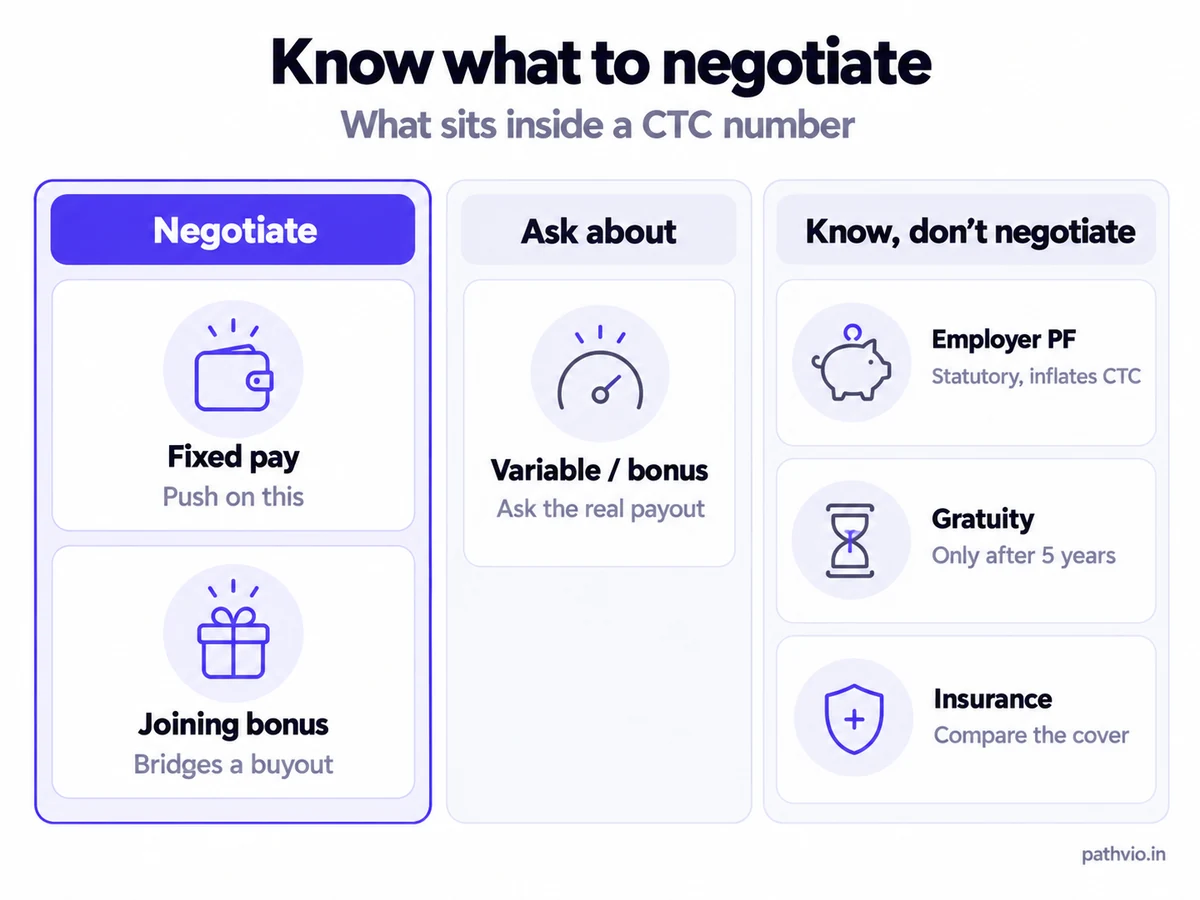
| Component | What it is | Negotiable? |
|---|---|---|
| Fixed pay | Guaranteed annual salary before variable and benefits | Yes — this is the number to push on |
| Variable / bonus | Performance-linked, often paid annually and rarely at 100% | Ask what the actual historical payout percentage has been |
| Employer PF | 12% of basic, paid by the company into your PF account | No — statutory, but it inflates the CTC headline |
| Gratuity | Accrued, but only payable after 5 years of continuous service | No — and treat it as zero if you do not plan to stay 5 years |
| Insurance / benefits | Group health cover, term life, sometimes meal cards | No, but compare the cover amount between offers |
| Joining bonus | One-time, often with a clawback if you leave within 12 months | Yes — useful for bridging a notice-period buyout |
The practical rule: negotiate on fixed pay, then confirm the split in writing before you accept. A package that is 40% variable is a different job offer from one that is 10% variable, even at identical CTC.
Gratuity is not money you are getting
It is included in the CTC headline but only becomes payable after five years of continuous service. If you expect to move before then, mentally subtract it when comparing offers.
Should you give a number or a range?
Give a range, and set its floor at the lowest figure you would genuinely accept. Recruiters negotiate from the bottom of whatever range you state, so the bottom is the number you have actually quoted. Keep the spread tight — roughly 15 to 20 percent — because a wide range signals you have not researched the role and invites them to test the low end.
What happens after you give the number?
Three follow-ups are near-certain. Have answers ready.
- "Is that fixed or CTC?" — Answer in fixed pay and say so explicitly. If you quote a CTC figure and they read it as fixed, the correction later is awkward and costs you credibility.
- "Do you have other offers?" — Only claim one if it is real and you would take it. Competing offers are verified more often than people expect, and an invented one is the fastest way to lose a process.
- "What's your notice period?" — This is a cost question, not small talk. A 90-day notice can reduce what a company is willing to pay, or prompt a buyout conversation. Our guide to reading an Indian offer letter covers what the notice and buyout clauses actually commit you to.
How do you negotiate salary after the offer arrives?
The offer call is the second negotiation, and usually the one with the most room. The structure is the same as before: show interest, name one fixed-pay number, give a one-line reason, and ask a question rather than state a demand.
The offer arrives below the band you researched
"Thank you — I'm keen on this role. Based on the scope we discussed and what this level pays in Pune, I was expecting closer to 30 lakhs fixed. Is there room to get there?"
Opens with interest, names one specific fixed-pay number, gives the reason in a single clause and ends on a question. A question invites a counter; a demand invites a defence.
They say fixed pay is capped for the level
"I understand the band is fixed. Could we look at a joining bonus to cover my notice-period buyout, or bring my first review forward to six months?"
Accepts their constraint instead of fighting it, and moves the money to the parts of the package that usually do have room.
You have a real competing offer
"I have another offer at 32 lakhs fixed. I'd rather join you because of the team and the product — can you get closer to that?"
States a verifiable fact and a genuine preference. It gives the recruiter something to take to their approver without sounding like a threat.
Never
"I have another offer at 40, so you'll need to match it."
An invented or inflated offer is checked more often than people expect, and an ultimatum leaves the recruiter nothing to do except refuse.
Never
"Okay, that works for me" — on the same call the offer is read out.
Accepting immediately ends the only conversation in which the number can still move. Ask for the offer in writing and a day to review it.
Whatever you agree, get it in the revised offer letter before you resign. A verbal promise of a joining bonus or an early review is easy to lose in a handover between recruiter and HR.
What else can you negotiate besides fixed pay?
When a company says the band is fixed, it usually means fixed pay for the level. Other parts of the package often still have room:
- Joining bonus — The usual way to cover a notice-period buyout or a bonus you forfeit by leaving. Check the clawback period in the offer letter.
- Level or title — A higher level moves the band itself, and every future hike is calculated from it. Worth asking about if your scope matches the next level.
- First review timing — An earlier review with a stated range is a real commitment if it is written into the offer, and close to worthless if it is not.
- Variable pay terms — Ask what the historical payout has actually been. A variable component that rarely pays out in full is not the number it appears to be.
- Notice and joining date — Some companies will buy out part of your notice period; others will wait. Either has a cost you can put a number on.
Practise the conversation out loud
Knowing the right words and saying them under pressure are different skills. The moment a recruiter says "this is the best we can do", most people either concede immediately or over-explain. Rehearsing the push-back out loud — once or twice, with the actual numbers from your offer — is what makes the scripts above come out the way they read.
Frequently asked questions
Before your next call
The scripts above only work if the band you quote is real. Research the market rate for the specific title, company tier and city you are targeting — not the national average for your job family, which is usually wide enough to be useless. Pathvio's salary guides break this down by role and city, and the JD fit scorer tells you how strong your case is for the top of a band before you name it.
One thing to check before the call happens at all: printing your current or expected CTC on the resume itself hands over the number before the conversation starts. That is one of the 14 resume mistakes that get candidates rejected — along with the formatting errors that stop a resume being parsed properly. If you apply through Naukri, the profile score guide covers what that platform measures separately.