Naukri Resume Score & Grading System Explained: What Each Grade Means and How to Improve It
- Naukri scores your profile 0–100 based on 8 factors — completeness accounts for the most points.
- Recruiters filter searches by score. Below 60 and you're largely invisible to active headhunters.
- Most people can hit 80+ in under 2 hours by filling gaps and uploading a refreshed resume.
- The score alone won't get you interviews — your headline + skills relevance matter more once you're visible.
If you've ever wondered why recruiters aren't reaching out despite years of solid experience, your Naukri resume score might be the first thing to fix. It's Naukri's internal ranking signal that determines how high your profile ranks when a recruiter searches for someone like you.
In this guide, we'll break down exactly how the score is calculated, what each tier means in practice, and the fastest fixes to push it above 80 — in roughly a weekend.
What is the Naukri Resume Score?
Naukri's Resume Score (also called the Profile Completeness Score) is a 0–100 metric that reflects how complete and relevant your profile is relative to what recruiters expect to see. It was introduced to help the platform rank candidates in search results and to nudge users into filling out their profiles fully.
The score is not a measure of your experience quality. It's a structural signal — Naukri's algorithm checking whether the fields recruiters care about are filled, fresh, and consistent. Two candidates with identical experience can have very different scores purely based on how completely they've filled their profiles.
Where to find your score
Log in to Naukri.com → click your profile photo (top right) → View Profile. Your score appears in a circular gauge at the top right of your profile. Below it, Naukri shows a checklist of the specific things keeping your score down.
What each score tier means for you
Below cutoff for most ATS filters. Profile rarely surfaced in searches.
Shows up in results but competes with many similar profiles. Hard to stand out.
Appears regularly in recruiter searches. Gets shortlisted for mid-level roles.
Surfaces at the top of recruiter search results. Higher InMail open rates from headhunters.
The sweet spot you're aiming for is 80+. At this level, you appear in the top tier of search results and Naukri's own recommendation engine (the one that sends your profile to recruiters proactively) is more likely to surface you.
The 8 factors Naukri uses to calculate your score
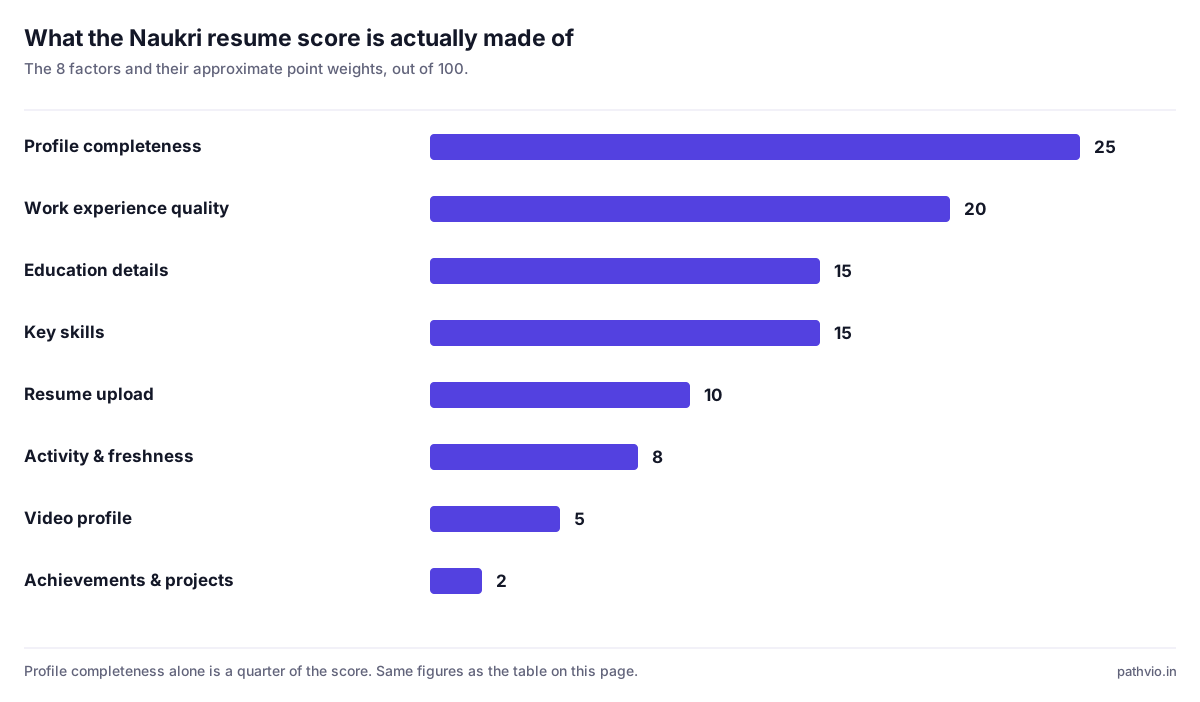
Naukri hasn't published the exact formula, but based on systematic profile testing and recruiter feedback, the score is built from 8 main components. Here they are with approximate point weights and the fastest fix for each:
Profile completeness
What Naukri checks: Photo, headline, summary, contact email confirmed
Work experience quality
What Naukri checks: Current designation, company, notice period, joining date
Education details
What Naukri checks: Degree, college, year of passing, percentage/CGPA
Key skills
What Naukri checks: Number of skills tagged, relevance to your role
Resume upload
What Naukri checks: Fresh resume attached (< 6 months old)
Activity & freshness
What Naukri checks: Last login, job applications, profile views responded to
Video profile
What Naukri checks: 30–90 second intro video recorded or uploaded
Achievements & projects
What Naukri checks: Awards, certifications, publications, key projects listed
Note on the video profile: Only ~10% of Naukri users record one, so the 5 free points it gives you are among the easiest to grab. A 60-second recording shot on your phone in decent light is sufficient. You don't need a studio or a script.
Step-by-step: How to improve your score this weekend
Here's the order in which to tackle fixes — highest return first.
Step 1 — Run a profile audit (5 minutes)
Open your Naukri profile and note every field with an incomplete or missing badge. The checklist below the score dial is your exact todo list. Screenshot it so you can work through it offline.
Step 2 — Complete personal details and photo (15 minutes)
Add a professional headshot (even a clean-background phone photo works), confirm your email, and fill in your current location and contact number. These are checked by the "Profile completeness" factor and are worth the most points.
Step 3 — Fill every work experience entry completely (30 minutes)
For each role: add the exact start and end dates, your designation as it appeared on your offer letter, the company name exactly as registered, your CTC at the time, and a 2–3 line description of your key responsibilities. Naukri penalises missing designation and missing dates.
Step 4 — Add 15–20 skills using Naukri's suggest tool (10 minutes)
Don't type skills manually — use the search box in the Skills section and pick from Naukri's own taxonomy. This ensures your skills match the exact terms recruiters are filtering on. For a software engineer, this means "Java" not "Core Java"; "React.js" not "ReactJS".
Step 5 — Re-upload your resume (5 minutes)
Even if your resume hasn't changed, download it, re-save it as a PDF, and re-upload. The "Resume upload" factor rewards freshness, and Naukri checks the upload date, not the content. Do this every 3 months. Before re-uploading, check your resume against Pathvio's free ATS checker to ensure it parses cleanly — broken formatting can hurt you even with a high Naukri score.
Step 6 — Record a 60-second video profile (20 minutes)
Introduce yourself: your role, years of experience, the kind of companies you've worked at, and one sentence on the type of opportunity you're looking for. Record in landscape mode with a plain wall behind you. Naukri's video profile tool is under your profile settings.
Step 7 — Log in and apply to 2–3 relevant jobs (10 minutes)
Activity is a live factor. After completing the above steps, apply to 2–3 jobs that actually match your profile. This signals to Naukri's algorithm that you're an active, engaged user — which boosts your placement in recruiter search rankings independently of the score.
Common mistakes that tank your Naukri score
Leaving 'Notice Period' blank or set to 'As per convenience'
Recruiters filter on notice period. Blank = invisible to urgent searches.
Using a resume last uploaded 12+ months ago
Naukri's freshness scoring drops significantly after 6 months.
Adding skills not in Naukri's taxonomy
Free-text skills don't match recruiter filter queries — zero discoverability value.
Hiding salary expectation
Recruiters with budget constraints skip profiles with no CTC expectation listed.
Long gaps in employment not explained
Naukri detects unaccounted gaps and penalises the work experience score.
Does the Naukri score actually matter? A recruiter's perspective
Yes — but it's the floor, not the ceiling. Here's how most tech recruiters actually use it:
- As a quick filter: When sourcing candidates, recruiters often set a minimum score of 60 or 70 in Naukri's RMS (Recruiter Management Suite). If you're below that threshold, you simply don't appear in their results, regardless of how strong your actual experience is.
- As a first-pass signal: A score of 80+ signals that you take your professional presence seriously — a minor but real positive signal when a recruiter is choosing between two otherwise similar profiles.
- Not as a quality metric: No experienced recruiter uses a Naukri score to judge your actual competence. Once you clear the filter threshold, the score becomes irrelevant — your experience, the quality of your headline, and your skills relevance take over.
The real bottleneck after 80+
If your score is already above 80 and you're still not getting calls, the issue shifts from discoverability to relevance. Your headline, current designation, and key skills need to match exactly how recruiters write their search queries. Pathvio's resume analysis helps identify these keyword gaps.
Beyond Naukri: your resume's deeper gaps
A Naukri score tells you whether your profile is complete — it can't tell you whether your resume is compelling for the specific roles you're targeting.
For example, a software engineer applying for a Staff Engineer role at a product company might have a Naukri score of 88 but still get rejected at the resume screening stage, because:
- Their bullet points describe tasks rather than outcomes ("built microservices" vs "reduced API latency by 40% serving 2M daily users")
- Key skills for Staff-level roles (system design, cross-team technical leadership) aren't reflected
- No evidence of mentorship or architectural ownership — the signals Staff-level JDs ask for
This is the kind of analysis Pathvio's AI resume tool does — it reads your resume against a specific job description and tells you the exact gaps, ranked by how much they're likely hurting your chances. If you want a detailed look at how Pathvio compares to Naukri's own resume tools, see our Pathvio vs Naukri comparison.
Frequently asked questions
The Naukri score measures your profile on Naukri. It says nothing about how the file you attach elsewhere is parsed, which is a separate check — the free ATS resume checker reads your actual resume and reports back in about a minute. No sign-up.
Related guides
- Software Engineer Salary in India (2026) — once your profile is discoverable, make sure your salary expectation is calibrated to market.
- How to Become a Product Manager in India Without an MBA — career transition guide for engineers and analysts.
- Skill Gap Analysis for Your Tech Career in India — identify exactly what to learn next to move to the next salary band.
- ATS Resume Format for India (2026) — make sure your resume clears automated screening before it reaches a human.
- 14 Resume Mistakes That Get You Rejected — the formatting and wording errors that stop a resume being read properly, each with its fix.